
Automation without contextual intelligence remains a form of cold outreach.
While email marketing platforms have significantly improved efficiency and scale, they often fail to address a more fundamental challenge: relevance.
In B2B environments, success is no longer determined by how many emails are sent, but by how well each message aligns with the recipient’s role, intent, and context.
What is Hyper-Personalization in Email Marketing?
Hyper-personalization in B2B email marketing uses AI, behavioral data, and contextual insights to deliver role-specific, highly relevant communication tailored to each recipient’s intent and stage in the buying journey.
Unlike traditional personalization, which relies on surface-level elements such as names or company details, hyper-personalization focuses on:
- The recipient’s role and responsibilities
- Their likely priorities and challenges
- Real-time intent and behavioral signals
The objective is to deliver communication that feels directly aligned with the recipient’s current needs and decision-making context.
Key Benefits of Hyper-Personalization:
- Improved response rates
- Higher engagement quality
- Reduced sales cycle duration
- Better lead qualification
- Increased conversion consistency
Why Traditional Email Automation Falls Short in B2B Marketing
Email automation has evolved to support scale and operational efficiency.
However, most systems are still built around execution mechanics rather than contextual understanding.
Typical capabilities include:
- Predefined sequences
- Scheduled follow-ups
- Template-based messaging
While these features improve efficiency, they do not address a critical question:
Who is this message intended for, and why is it relevant to them?
In B2B communication, messages are not evaluated by organizations, but by individuals within them.
Each role interprets value differently:
- IT leaders prioritize integration, security, and compliance
- HR leaders focus on process efficiency and employee impact
- Sales leaders evaluate revenue potential and pipeline acceleration
When identical messaging is distributed across these roles, its effectiveness diminishes significantly.
Moving Beyond Surface-Level Personalization
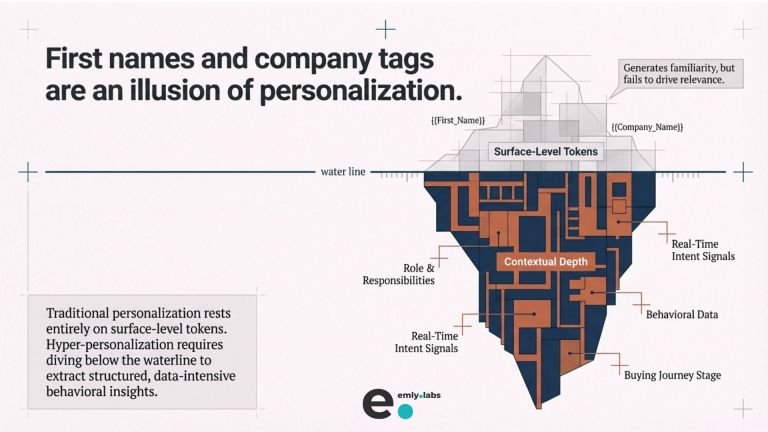
Traditional personalization techniques—such as including a recipient’s name or company—offer limited impact.
They improve familiarity, but not relevance.
Hyper-personalization requires a more structured approach, beginning with clarity on:
- The target business and its operational context
- The product or service being offered
- The specific role being addressed
- The intended outcome of the campaign
Once this context is established, messaging can be adapted accordingly.
For example:
- Communication to IT stakeholders may emphasize system compatibility and compliance
- Messaging for HR may focus on workflow optimization and efficiency
- Outreach to Sales teams may highlight revenue growth and conversion improvements
This level of alignment transforms email marketing from broad communication into targeted engagement.
How to Implement Hyper-Personalization in B2B Email Marketing
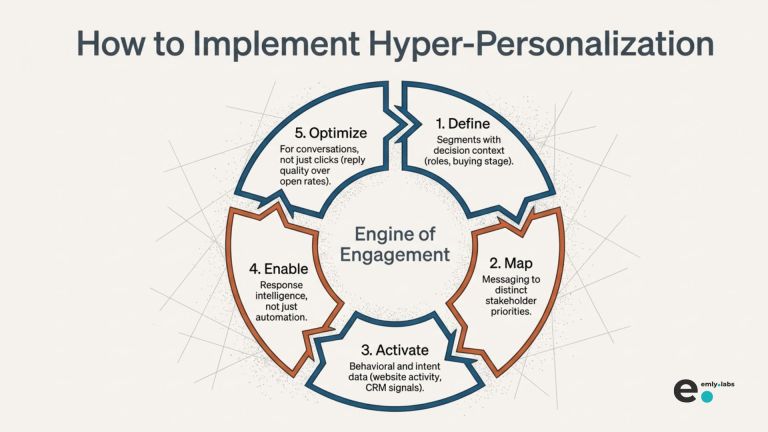
Moving from concept to execution requires more than adding personalization tokens. It demands aligning data, messaging, and engagement logic around how B2B buyers actually make decisions.
Key steps include:
- Define audience segments with decision context
Go beyond basic segmentation. Identify roles, buying stage, and influence level within the decision-making unit. - Map messaging to stakeholder priorities
A CFO, a marketing head, and an operations lead evaluate value differently. Your messaging should reflect these distinct perspectives. - Activate behavioral and intent data
Use email interactions, website activity, and CRM signals to understand where the prospect is in their journey—and respond accordingly. - Enable response intelligence, not just automation
Hyper-personalization doesn’t stop at sending emails. It extends to how replies are handled, ensuring every response is contextual and relevant. - Optimize for conversations, not just clicks
Open rates and CTRs are surface metrics. Focus on reply quality, engagement depth, and progression in the sales cycle.
- Define audience segments with decision context
Why Email Responses Matter in Personalized Campaigns
Even when outbound messaging is well-structured, most campaigns fail at the engagement stage. A prospect replies — and that is exactly where most automation systems relinquish control.
Replies are routed manually, answered with standardized responses, or left waiting. This introduces friction and inconsistency at the most critical moment of the entire interaction.
A mature hyper-personalized system must extend beyond outbound messaging into response intelligence. When a reply is received, the system must be capable of:
- Reading the customer’s message carefully — not skimming for keywords
- Identifying intent: pricing inquiry, technical question, buying signal, or objection
- Acknowledging their specific questions, interests, or comments
- Providing clear, relevant next steps — a call, more information, a demo
- Escalating high-intent leads to the sales team at the right moment
- Maintaining contextual continuity across every touchpoint
Without response-level orchestration, personalization collapses at the point of highest leverage. Our system’s AI-powered response configuration does not send a template. It generates a reply that feels like a human wrote it — because the context instructs the AI to respond to what the customer actually wrote, not what was expected.
The progression of a conversation is as important as its initiation.
That is where deals are actually won.
Lead Awareness: Precision Over Volume
Mass outreach strategies prioritize list size and send frequency. While scale increases visibility, it does not inherently improve relevance — and in B2B markets, irrelevance is expensive.
Hyper-personalized systems operate under a fundamentally different philosophy. The objective is not to reach more people. It’s to reach the right people. The objective is to engage the most contextually aligned prospects and progress those conversations intelligently.
Through CRM integration, lead pool configuration, and metadata mapping, our system pulls contextual information about each prospect before writing to them. This means when a cafe owner receives an email about premium natural plant products, the message references their world — brewing, flavor, sourcing, quality — not a generic pitch about natural goods.
When role awareness, offer clarity, behavioral logic, and response handling are integrated within a unified system, email marketing shifts from probabilistic outreach to precision-driven engagement:
- Improved response quality — leads reply with intent, not curiosity
- Shorter sales cycles — context reduces friction at every stage
- Reduced lead wastage — the right message reaches the right person
- Stronger conversion consistency — not dependent on luck or timing
The shift toward hyper-personalization is supported by consistent industry data.
According to Accenture, 91% of consumers are more likely to shop with brands that provide relevant offers and recommendations. This trend continues today, with modern research showing that customers increasingly expect personalized, real-time interactions from brands.
89% of business leaders say personalization is critical to success in the next 3 years
In B2B environments—where decisions involve multiple stakeholders—this expectation for relevance becomes even more critical.
A New Standard: Systems That Think Before They Send
The next generation of email marketing platforms will not differentiate themselves through deliverability metrics or interface design alone. They will differentiate themselves through contextual intelligence.
The systems that will define B2B email marketing going forward are those that understand:
- Who is being addressed — their role, their priorities, their world
- Why the message is relevant to that specific person at that specific moment
- How engagement signals should alter the progression of the conversation
- When escalation is required and how to hand off without losing momentum
This is not a cold email tool. Cold email tools optimize for deliverability and open rates. Hyper-personalized campaign orchestration optimizes for relevance, context alignment, intelligent follow-ups, and conversion progression.
The goal is not to reach more.
The goal is to reach right — every time, for every role, at every stage of the conversation.
The Competitive Imperative
As B2B markets become increasingly competitive and attention becomes increasingly scarce, relevance will outperform volume. Every time.
The future of email marketing will not belong to teams who send the most. It will belong to teams who understand who they are talking to, why it matters to that person right now, and how to progress the conversation intelligently from first send to closed deal.
Automation alone creates efficiency. Automation with hyper-personalization creates strategic advantage.
Volume-based outreach is a gamble. Precision-driven engagement is a system.
In modern B2B marketing, advantage compounds. Build yours now.
Ready to run your first hyper-personalized campaign? Configure the context, define your audience, and let the system advance every conversation intelligently — from first send to closed deal.Platforms like Emly Labs are being designed to operationalize this shift—bringing contextual intelligence into every stage of email engagement.