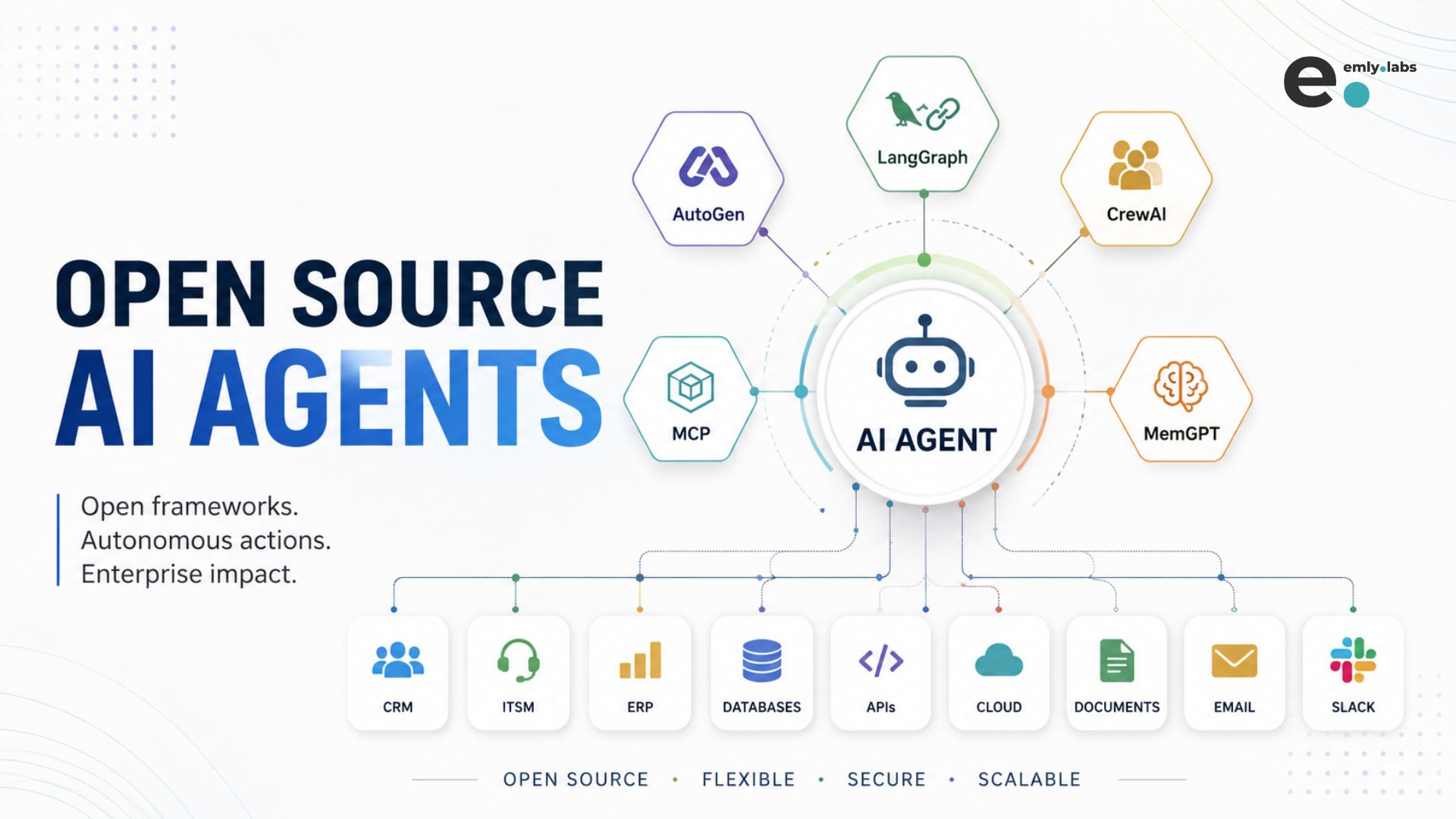
The shift from AI assistants that answer questions to AI agents that take action is already underway. But what’s driving the speed? Not billion-dollar labs working in secret — it’s the open-source ecosystem, quietly compressing a decade of development into eighteen months.
Two years ago, the most common enterprise AI use case was a chatbot that could draft an email or summarize a meeting transcript. The human still did the work. The AI suggested. Today, organizations are deploying systems that don’t just suggest — they act. They book, escalate, remediate, and report, often without a human in the loop at each step.
This is the agentic shift. And if you’ve been watching the enterprise software market, you’d be forgiven for thinking it was led by the big incumbent platforms. It wasn’t. The real engine has been far less visible, and far less controlled: the global open-source developer community.
What Are Open Source AI Agents?
Open source AI agents are autonomous software systems built using publicly available frameworks that can reason, plan, interact with external tools, and execute tasks with minimal human intervention. Unlike traditional AI chatbots that primarily respond to user queries, AI agents can perform actions such as updating enterprise systems, orchestrating workflows, retrieving information, and collaborating with other agents to complete complex business processes.
The growing availability of open source AI agent frameworks has made it easier for organizations to build enterprise-grade AI solutions without relying entirely on proprietary platforms. As a result, businesses can innovate faster, customize deployments to their needs, and avoid excessive vendor lock-in.

From “answer me” to “do it for me”
The line between a chatbot and an agent is not technical jargon — it’s a meaningful operational boundary. A chatbot is a better search engine. An agent is a junior colleague with system access. It can read your incident queue, classify tickets by urgency, draft resolutions based on past cases, update the ITSM record, and notify the responsible team — all from a single trigger.
That capability, which would have required months of custom integration work two years ago, is now achievable in days using open-source frameworks like LangGraph, AutoGen, and CrewAI. These aren’t hobby projects. Microsoft’s AutoGen framework has been adopted by enterprise teams at Accenture, PwC, and several financial institutions as the backbone for multi-agent orchestration workflows. LangChain’s LangGraph extension — which allows developers to define stateful, cyclical agent pipelines — became one of the most starred repositories on GitHub through 2024 and into 2025.
Why Are Enterprises Adopting Open Source AI Agents?
Organizations are increasingly adopting open source AI agents because they offer greater flexibility, transparency, and control than proprietary alternatives. Instead of waiting for software vendors to release new capabilities, enterprise teams can adopt the latest open source frameworks, customize them for specific business workflows, and integrate them with existing enterprise applications.
Open source AI agents also encourage innovation through active developer communities that continuously improve frameworks, fix issues, and introduce new capabilities. This collaborative development model has significantly accelerated enterprise adoption of agentic AI.
The agentic revolution wasn't launched from a corporate war room. It was assembled, committed, and pull-requested into existence by developers sharing building blocks across time zones.
Leading Open Source AI Agent Frameworks
Several open source AI agent frameworks have emerged as foundational technologies for enterprise AI. While each addresses a different aspect of agent development, together they form the building blocks of modern agentic systems.
| Framework | Primary Purpose |
|---|---|
| LangGraph | Stateful multi-step AI workflows |
| AutoGen | Multi-agent collaboration |
| CrewAI | Role-based AI agents |
| MemGPT | Long-term memory management |
| MCP | Standardized tool integration |
Three open-source developments every enterprise leader should understand
Multi-agent orchestration:
AutoGen and the rise of collaborative agent networks
Persistent memory & learning
MemGPT: agents that remember across sessions
Integration layer
Model Context Protocol (MCP): the USB standard for AI agents
Why open source is the accelerant, not the platform vendors
It would be natural to assume that the dominant enterprise AI platform vendors — ServiceNow, Salesforce, SAP — are driving the agent adoption curve. And to be fair, they are investing heavily. ServiceNow’s Now Assist and Salesforce’s Agentforce are real products with real deployments. But the velocity of capability innovation is happening in open source first, and the platforms are catching up to it, not leading it.
The structural reason is straightforward: open-source development is parallelized. When a researcher in Tokyo publishes a new memory architecture, a developer in Berlin can fork and adapt it within hours. The enterprise platform vendor has a product roadmap, a compliance review cycle, and a quarterly release calendar. The open-source ecosystem has a pull request.
This is not a critique of enterprise vendors — their value lies in reliability, security, and support, not raw innovation velocity. But it does mean that the organizations reaching deployment-ready agentic workflows fastest are those building on open foundations, not waiting for the next platform release.
67% of enterprise AI pilots in 2025 incorporated at least one open-source component. That number will be higher for agentic workloads — the closed-source tooling simply doesn't exist at the same level of maturity yet.
Open Source AI Agents vs Proprietary AI Agents
| Capability | Open Source AI Agents | Proprietary AI Agents |
|---|---|---|
| Customization | High | Moderate |
| Vendor Lock-in | Low | High |
| Innovation Speed | Very Fast | Vendor Release Cycle |
| Community Support | Global | Vendor Only |
| Cost Flexibility | Higher Control | License Dependent |
The real challenges aren’t technical — they’re structural
The capability question is largely answered. Agents can act. The harder question is whether your organization is ready for them to act on your behalf. Three structural challenges are slowing enterprise adoption more than any technical barrier.
- 01
Shadow AI proliferation. When developers discover capable open-source agent frameworks, they use them — on their laptops, connected to corporate systems, without security review. Gartner estimates that the majority of AI-related security incidents in 2025 involved unauthorized AI tool use by employees, not external attacks. Providing governed, approved frameworks is not optional.
- 02
Process redesign debt. Most organizations are deploying agents to speed up existing workflows. The larger opportunity — the one that produces 10x outcomes rather than 1.3x — is redesigning the process itself around agentic capability. This requires cross-functional leadership engagement, not just an IT project.
- 03
Data and memory governance. As agents develop persistent memory — recall of past interactions, user preferences, institutional context — the governance questions become significant. Who owns that memory? How is it audited? What happens when an employee leaves? These aren’t hypothetical: they are live questions in current deployments.
- 01
Despite their advantages, open source AI agents introduce new operational responsibilities. Organizations must evaluate framework maturity, maintain dependencies, monitor security updates, establish governance policies, and ensure AI agents operate within clearly defined boundaries. Successful enterprise adoption depends as much on governance as on technical capability.
Frequently Asked Questions About Open Source AI Agents
What are open source AI agents?
Open source AI agents are AI systems built using publicly available frameworks that can reason, use external tools, and complete tasks autonomously.
How are AI agents different from AI chatbots?
Traditional chatbots primarily answer questions, while AI agents can execute actions, automate workflows, and interact with enterprise systems.
What are the most popular open source AI agent frameworks?
Popular frameworks include LangGraph, AutoGen, CrewAI, MemGPT, and the Model Context Protocol (MCP).
Are open source AI agents secure?
Yes, provided organizations implement appropriate governance, access controls, monitoring, and security practices. Open source provides transparency, but enterprises remain responsible for secure deployment and maintenance.
Why are enterprises choosing open source AI agents?
Open source AI agents provide greater customization, faster innovation, lower vendor lock-in, and flexibility to integrate with existing enterprise technology stacks.
What this means for enterprise leaders in 2026
The competitive dynamics of AI adoption have shifted. A year ago, the question was whether to invest in AI pilots. Today, the question is whether your operational backbone can support agents at scale — and whether you have the governance architecture to do it safely.
The organizations pulling ahead are not necessarily those with the largest AI budgets. They are those that established clear frameworks for responsible open-source adoption early, gave technical teams governed access to frontier tooling, and invested in redesigning processes — not just automating them.
Open source didn’t just democratize access to AI. It compressed the timeline from research to enterprise deployment to a degree that no single vendor could have achieved. The agent era is here not because a platform provider shipped a new feature. It’s here because thousands of developers, researchers, and organizations shared the building blocks needed to make it real.
The most important action is also the simplest: begin now, begin deliberately, and build the organisational capability to learn as the technology continues to evolve.